
Stories from the field
“Everyday life in communities in Luuka district begins early in the morning, with men heading to the fields or sugarcane plantations and women managing household chores and gardens. Children, too, engage in light chores before school, but many boys, particularly those not in school, seek work in plantations or trading centers. During my placement, I observed boys sneaking out of sugarcane plantations at midday to change into school uniforms before heading home or to school. On weekends, boys as young as ten years carried blades to work in the fields.”

This excerpt above is from a story written by Monicah Nampala who is a master’s student at Makerere University in Uganda. It gives a glimpse into a problem facing many rural communities. Children drop out of school in the favor of working in emerging industries. In Community Social Labs and Social Work Monicah and other students share stories from the field, detailing how they have worked with local communities to find solutions to social problems such as school dropout among children. There are stories of initiatives to raise awareness and find practical solutions to problems that keep children out of school, such as growing vegetables and setting up “talking signs” in the school yard, making reusable sanitary pads for girls, and sharing experiences through books and songs. There are stories of income-generating activities, such as mushroom growing, braid making, mat-weaving and poultry farming. And there are stories of initiatives to create safer communities through parenting groups and collaboration with stakeholders. The stories give testimony to the value of the CSL approach. In these short videos, Martha Niyigena and Rogers Niwamanya share how both communities and themselves have benefitted from the approach.
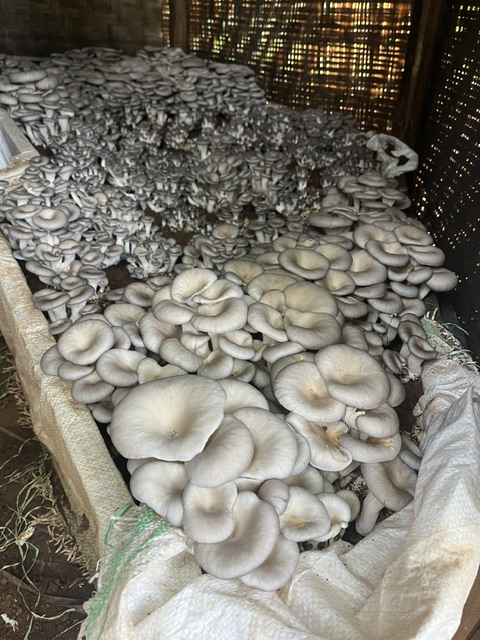
“Through community dialogues and stakeholder consultations, a lack of employment opportunities and start‑up capital emerged as major obstacles for youth. The youths felt disempowered, unable to improve their living conditions, and lacked the support or stimulation needed to broaden their horizons. One day, during a community outreach activity organized by our CSL team, an awareness‑raising session was held with the youth. Very interestingly, the talks delivered by staff and students resonated strongly, inspiring the youth to engage in small income‑generating projects with conviction – captured in the Rwandan proverb “Ak’imuhana kaza imvura ihise”, meaning “It is better to be self‑reliant because assistance from outside is unreliable and unpredictable”. After evaluating different scenarios, local resources, and potential ventures, the youth identified mushroom growing as a promising project. The choice was based on several factors: low start‑up costs, suitability to the local climate, high nutritional value, and strong demand in urban markets.”
(Innocent Kayumba, Martha Niyigena and David Nshimyumukiza, University of Rwanda)

b
“Walking through the village every evening, one of the most intriguing practices we observed was women sitting on their verandas, weaving traditional mats after a long day of domestic work. It was a minimally physically demanding activity that had been done for generations. The elderly women often plaited the mats more out of habit without any thought of selling them, and they were made from natural materials found in the community. Recognizing the potential of this cultural tradition, we suggested that the older people formalize mat weaving as a structured income‑generating activity.”
(Frank Yonakia, Institute of social work, Tanzania)

